

 ABOUT
ABOUTAs the city recovers from the COVID-19 pandemic, Market will continue to be an important multi-modal corridor, integrating three levels of public transportation that serve the millions of people who live, work and visit San Francisco. Additionally, cycling is becoming increasingly popular mode of personal transportation, with bicycles outnumbering motorized vehicles at various times throughout the day.
The existing design accommodates the demands of the various modes, but it falls short of its potential. There are points of significant conflict between bicycles and vehicles; large volumes of fast-moving traffic crossing Market Street create barriers for pedestrians; and the odd angles of intersections on the north side result in unusually long and awkward places for people to cross. In January 2020, the City restricted private vehicles from driving along Market Street. The city believes more can and should be done to make travelling through the corridor more efficient, safe and comfortable.
Overarching Mobility Goal for Market Street:
Optimize sustainable mobility modes (transit, walking, rolling and cycling) to be pleasant, reliable, efficient and safe for all users.Achieving this vision, however, will require changes to how the roadway is designed, which modes get priority in the limited roadway, and how vehicles circulate throughout the area. In addition, the mobility demands placed on Market Street will need to be balanced against the need for creating more inviting public spaces.
In January 2020, the city implemented Car-free Market Street, a quick-build project that restricted private vehicle traffic from the corridor between Van Ness Avenue and Steuart Street, extended Muni only lanes, created new loading zones and included much-needed intersection safety improvements. These improvements, coupled with the COVID-19 pandemic’s impact on transit ridership and office attendance, produced a significant increase in bicycle ridership in the first half of 2020. These ridership numbers would have exceeded the capacity of the sidewalk-level bikeway design included in the project’s original design.
The COVID 19 pandemic’s impact on the way urban spaces are used, as well as the city’s financial situation, prompted city leaders to propose a revised design concept for Better Market Street that was presented at a series of public meetings and open houses in Fall 2020.
As San Francisco began to emerge from the pandemic in early 2021, city department leaders again asked the project team to ease San Francisco’s economic recovery efforts by minimizing construction related impacts on local business activity and transit service. After developing and evaluating alternatives in 2021, Public Works and SFMTA agreed to move forward with an alternative design for Phase 1 that delivers key safety and infrastructure improvements.
Please visit this site frequently to learn of upcoming events, project updates, and to share your thoughts and ideas. Please email bettermarketstreet@sfdpw.org to give your comments and to be added to the mailing list announcing open participation events.
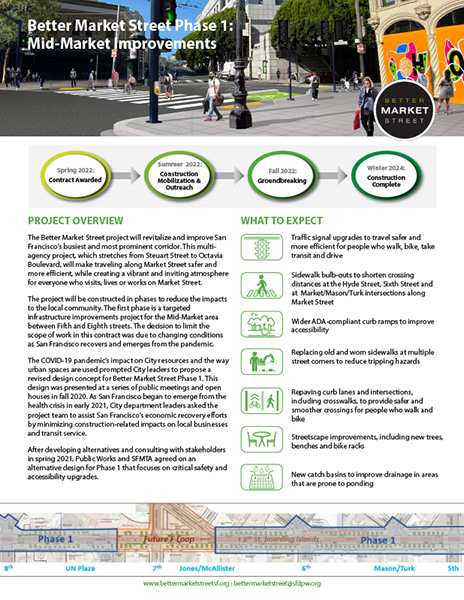
Click here to download the
Better Market Street:
FACT SHEET
